A Bakers Dozen Threats To American Democracy
Political situations are never static. Here are some of what I perceive to be the current threats to American democracy as of mid-January, 2026, in no particular order.
American Democracy, as understood in this context, is the constitutional system of representative government where people elect their representatives and hold them responsive to public opinion through the electoral process. The rule of law (no individual being above the law) and individual rights are part of this system.
The Main Threats To American Democracy
1. Erosion of Democratic Norms
Declining acceptance of the legitimacy and accuracy of elections when one's preferred candidate loses. A prominent example is the denial of results of the 2020 election and actions taken by deniers to set aside the election results.
Politicians breaking long-standing norms (e.g., the important rituals of the peaceful transfers of power after an election) and directly attacking the process. Name calling and demonization of opponents fall into this category also.
2. Attacks on Voting Rights
Restrictive laws that reduce access to voting (reducing early voting, purges, ID limits without alternatives) designed to discourage or prevent voting by minorities.
Gerrymandering that lets politicians pick their voters rather than the reverse.
Unequal polling access that disproportionately affects rural, elderly, minority, and low-income voters.
3. Election Subversion and Misinformation
Organized efforts to spread false claims about elections.
Pressure or violence to election officials leading to resignations and the resulting loss of institutional knowledge of electoral administration.
Attempts to replace professional election administrators with partisan actors.
Deepfake video/audio content increasingly misleads voters.
4. States Manipulating Federal Democratic Structures
Extreme partisan gerrymandering creating uncompetitive districts.
"Democratic backsliding" in certain states experimenting with anti-majoritarian laws, e.g., stripping powers from elected officials, restricting protests.
State legislatures passing laws that interfere with county election boards.
5. Political Violence and Intimidation
Threats against election workers, judges, school board members, legislators, journalists and public officials.
Normalization of violent rhetoric in political discourse.
Extremist groups exploiting social media to organize harassment or disruption.
6. Weakening of the Checks & Balances System
Increasing partisanship in Congress, reducing its willingness to act as a check on the executive or agree on legislation.
Overreliance on executive action in the absence of legislation.
Executive Aggrandizement: Extra-constitutional expansion of presidential power. In 2025, using emergency powers to bypass Congress (e.g, sweeping tariffs, and using pardons for partisan loyalty.
Judicial appointments for partisan purposes and the resulting judicial politicization that erodes public trust.
Foreign raids and wars without consulting Congress or even advance briefing them in advance as required.
Domestic use of the military.
7. Capture or Undermining of Institutions
Efforts to delegitimize independent courts, the Department of Justice, the civil service and regulatory agencies.
Attempts to use government power to punish political opponents, favor allies or enrich those in office.
Politicization of leadership in the military and law enforcement.
8. Social and Information Challenges
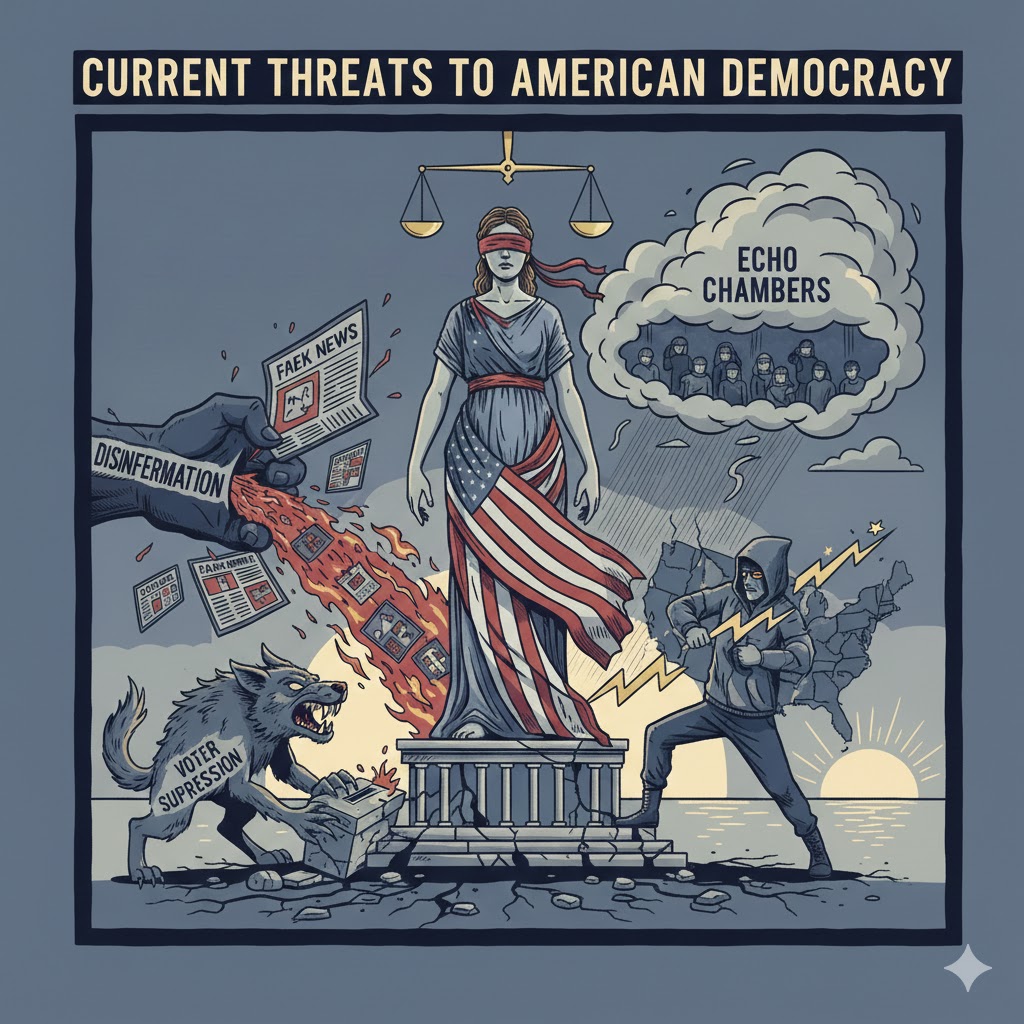
Spread of disinformation and misinformation, particularly on social media.
Foreign interference attempts in elections and political discourse.
Erosion of objective news and replacement by echo chambers that reinforce existing beliefs and increase polarization.
9. Declining Civic Education and Participation
Lack of good civics education and poor understanding of how government works.
Low voter turnout in primaries, local elections and off-year contests—where many crucial decisions are made.
Generational disengagement and lack of trust in institutions.
10. Economic Inequality and Loss of Institutional Trust
Poverty and economic uncertainty for the middle and lower classes that increases susceptibility to radicalization and scapegoating.
Wealth-concentrated lobbying and campaign finance systems giving outsized influence to a small number of rich donors.
11. Constitutional Stress Points
Outdated mechanisms like the Electoral College, the Senate filibuster and uneven representation creating minority rule scenarios.
Ambiguities in the Constitution (e.g., roles in certifying elections) being exploited.
Declining trust in democratic institutions, including Congress, the media, and the electoral system.
12. Technological Threats
Foreign and domestic actors using sophisticated influence operations and automated bots for disinformation.
AI-generated false news, images, and video accelerating distrust.
Algorithm-driven social media amplifying outrage, extremism, and falsehoods.
Cyberattacks on election infrastructure or voter databases.
13. Political Polarization
Deep partisan divisions that make compromise difficult.
Growing tendency to view political opponents as threats rather than legitimate competitors.
Erosion of shared factual foundations due to media fragmentation and disinformation.
Next time, we will examine possible roads to remedy these attacks on democracy.