American Democracy By The Numbers: A Measurable and Alarming Decline
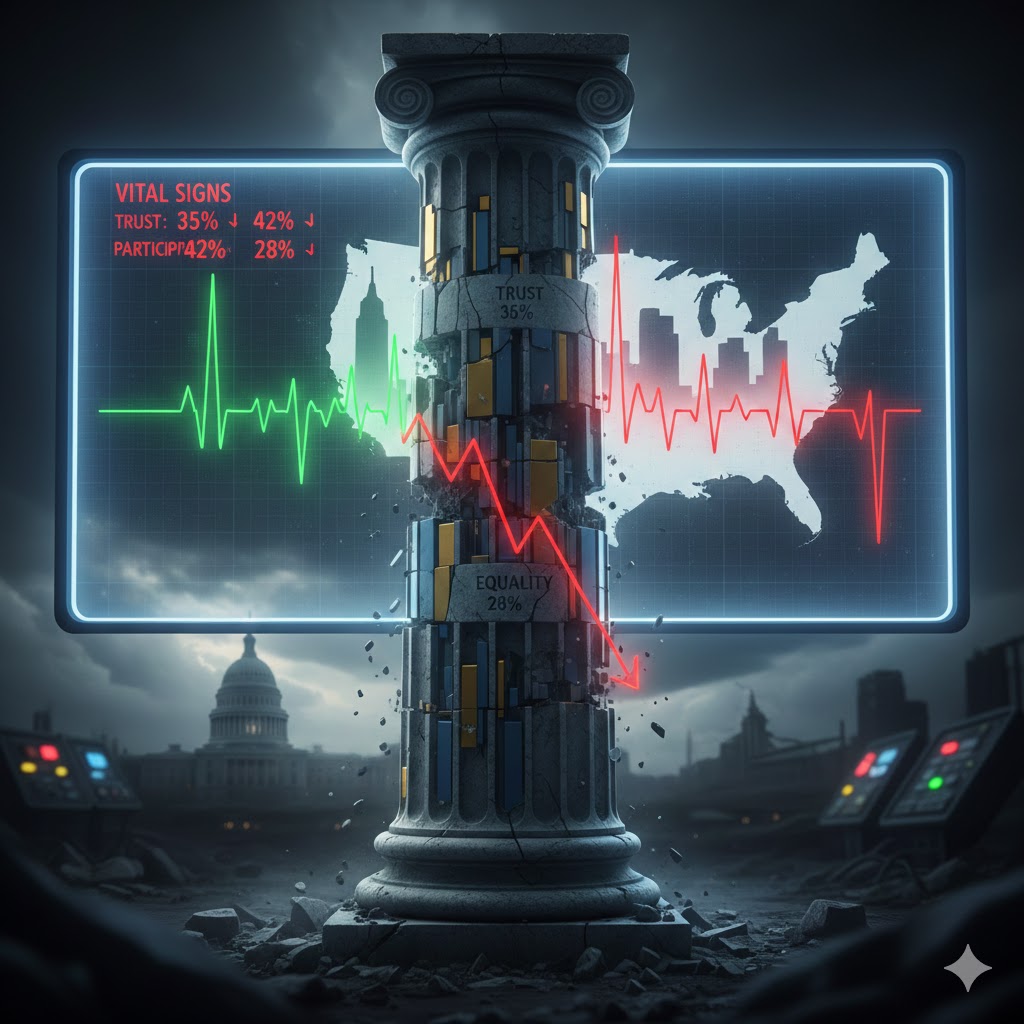
American democracy is in trouble and it's getting more serious as time passes. The numerical picture that emerges from multiple independent global democracy assessments is both clear and alarming: American democracy is in measurable decline and the trajectory is getting steeper.
The highly-respected Swedish V-DEM Institute Index for 2024 ranks the United States as 24th internationally in democracy, e.g., 23 nations are ranked more democratic than the U.S. and they cite the U.S. as moving further away from democracy in their 2025 report.
The Economist Magazine Democracy Index, another very credible measure of democratic health globally, currently ranks the United States 28th in the world with a score of 7.85 out of 10. They have classified the U.S. as a "flawed democracy" rather than a "full democracy" since 2016.
Freedom House gives the United States a score of 84 out of 100 in their Freedom in the World 2025 assessment. Over the past 13 years, the United States has dropped 11 points, currently far behind democratic peers like Canada, Germany and the Nordic countries that consistently score above 90.
International IDEA's Global State of Democracy 2025 identifies the USA as among the 10 countries with the largest drops in their democracy index. The U.S. score fell from 0.69 in 2019 to 0.59 in 2024—a significant decline in just five years.
The Century Foundation's Democracy Meter rates the United States at just 57 out of 100 for 2025, representing a 28 percent drop in a single year.
What These Rankings Measure
These assessments are not based on opinion or party preference. These reputable and independently-acting organizations evaluate the concrete factors of government functioning, political participation, political culture, civil liberties and the electoral process.
Concerns cited across these assessments include political polarization reaching levels that impede governance, congressional dysfunction that prevents addressing critical issues, growing economic inequality that translates into political inequality, declining trust in democratic institutions and policy actions that weaken democratic norms and protections.
In comparison, nations that consistently rank as the world's strongest democracies—Norway, Sweden, Iceland, and Finland—score above 9 out of 10. These democracies have maintained strong institutions, high civic participation and effective governance even amid global challenges. The U.S. ranks below Costa Rica (17th), Uruguay (15th) and New Zealand (4th).
These trends transcend particular U.S. administrations. They measure the health of the political system itself—the foundation that determines whether any government, regardless of party, can function democratically and is accountable to its citizens.
These issues transcend party lines. For example, gerrymandering distorts representation. It doesn't just affect one party—it undermines the principle that voters should choose their representatives rather than the reverse. Similarly, when unlimited money floods into campaigns, it doesn't just tilt elections. It creates a system where wealth increasingly determines who gets heard. When political polarization prevents basic governance, it doesn't just create gridlock—it erodes faith in democratic problem-solving itself.
Not only is the U.S. ranked consistently low as a democracy, the rate of U.S. democratic decline is accelerating. The Century Foundation's reported 28 percent drop in one year suggests we may be entering a more acute phase of democratic erosion. This acceleration matches what we see in the International IDEA data, where most of our decline occurred in the past five years rather than being spread evenly over a longer period.
This pattern is characteristic of democratic backsliding globally: gradual erosion can suddenly accelerate when certain thresholds are crossed. Key institutions weaken, norms erode and what were once stabilizing features of the system begin to fail.
Mounting A Stout Defense of Democracy
As I've written before, democracy doesn't defend itself. It requires informed, engaged citizens who understand not just current events but the underlying systems and principles at stake. This is why I've consistently argued for robust civic education as a cornerstone of any effort to strengthen American democracy.
But civic education isn't enough. We also need meaningful structural reforms that address the specific weaknesses these assessments identify. This includes tackling gerrymandering through independent redistricting commissions, implementing campaign finance reforms that reduce the influence of concentrated wealth, exploring electoral innovations like ranked-choice voting that can reduce polarization and improve representation and strengthening democratic norms through both formal protections and cultural commitment to democratic principles.
We know what strong democracies look like. The countries at the top of these rankings invest in civic infrastructure, protect democratic institutions, ensure broad political participation and maintain systems that balance efficiency with accountability.
None of this is beyond the capabilities of the United States. But as Americans we must recognize the problem, understand its depth and commit to solutions that go beyond the next election cycle.
Democracy as a Living System
Democracy is not a static achievement but a dynamic system that requires constant maintenance and improvement. Like any system, it can degrade over time if not actively maintained.
The question isn't whether we should be concerned but what we should do about this. These alarm bells are ringing loudly, and we as concerned citizens must be among the first responders to this emergency.
Every point we've lost in these rankings represents a weakening of that system. Every year we continue down this trajectory makes reversal harder. But history shows that democratic renewal is possible when citizens recognize the problem and commit to the work of reform.
The numbers don't lie. American democracy is in trouble. What we do with that information is up to us.