Artificial Intelligence and Democracy: Will It Be a Force For Good or Bad?
Artificial intelligence (AI) is a reality and has emerged as a tool with an increasingly significant impact in all sectors of society, including government. In American democracy, it is already playing an increasingly important element of news gathering and dissemination, citizen contact with their representatives, ballot handling and security and legislative drafting.
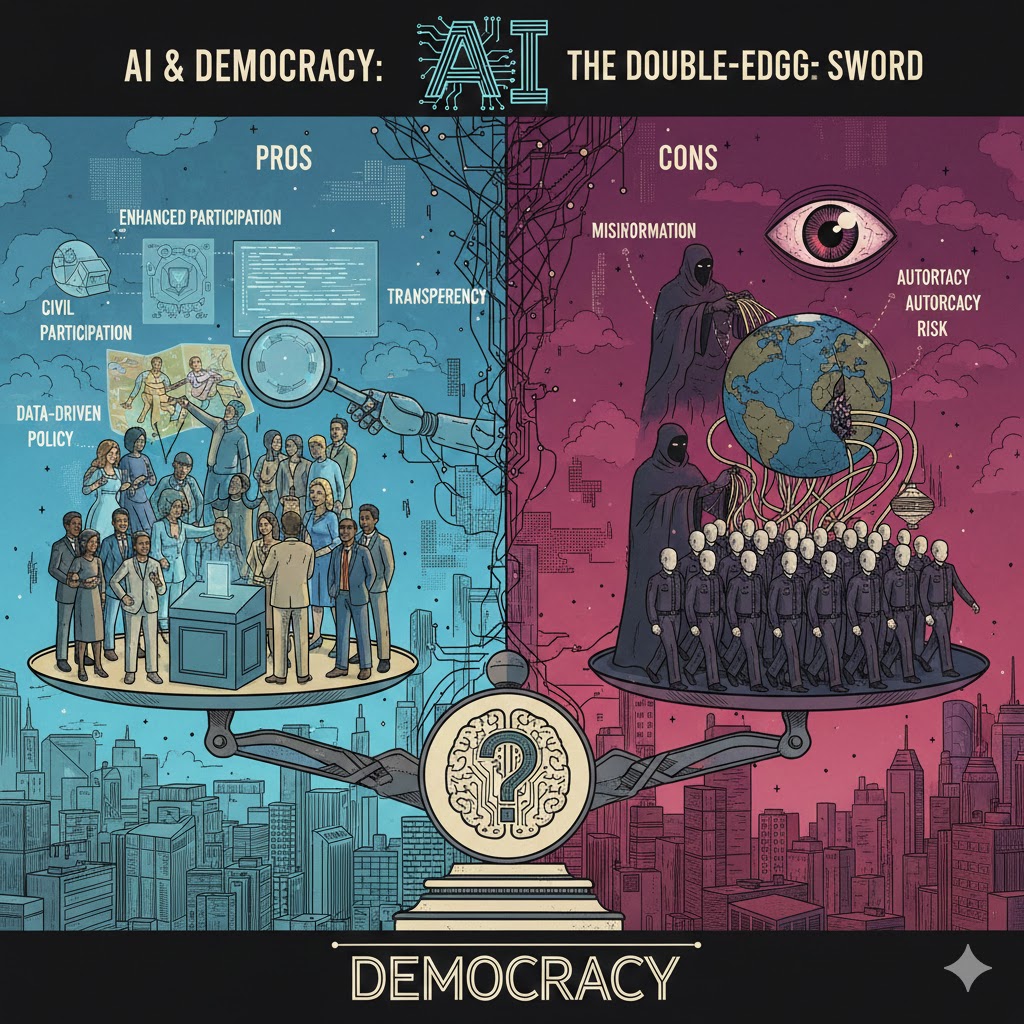
AI can be a force for erosion, if not the outright destruction of democracy or a force for its enhancement in the future.
One future envisions aggressive, potentially independent non-human intelligence with a mind of its own that takes it where it wants to go, regardless of the wishes of those who created it. Fully developed as such, it is likely to supersede government as we know it.
The other future envisions AI as a loyal servant of its creators with the potential to empower citizens to acquire the civic information necessary for a functioning democracy and use it to express their opinion democratically and effectively in the political system.
Which future is more likely to emerge in the future of democracy for rest of the 21st century? I don't have a crystal ball but I do worry about it and so should you.
AI as a Threat to Democracy
If the independent and aggressive mind dominates, AI can provide the tools for digital authoritarianism and the systemic collapse of shared reality.
The rise of generative AI has made disinformation cheap and scalable. With widespread use of deep fakes and AI-generated and disseminated lies, voters find it very difficult if not impossible to distinguish fact from fiction. Moreover, an AI that has reached so-called singularity (a mind of its own and independence) almost certainly will replace sometimes messy and slow-moving democracy with a more efficient totalitarianism.
Because AI allows very precise microtargeting, democratic campaigns as we know them can be rendered obsolete. Hyper-personalized messages can exploit individual psychological vulnerabilities, deepen polarization and supersede the free marketplace of ideas necessary for democracy.
AI algorithms can replace human judgement in criminal justice, social welfare program eligibility, automate favoritism for a certain group and shred the notion of the rule of law and due process. They can help governments conduct mass surveillance and suppress the free speech and dissent necessary for democracy.
AI as a Democratic Catalyst
On the other hand, AI can be viewed as a potentially powerful set of tools to improve and operationalize democracy. Seen this way, it can act as a bridge rather than a barrier to allow citizens to understand and control complex governance, fostering a more Jeffersonian ideal of an informed and engaged electorate that bends government to its will.
This vision of AI in government can enhance civic power for all by using Large Language Models (LLMs) of AI to complex legislative jargon into plain language. It can also help citizens articulate their views in public consultations, overcoming obstacles related to education, language, remote locations or disability. It can also serve as a tool for grass-roots mobilization and information dissemination.
Moreover, AI can enable better governance by using predictive analytics to optimize public service delivery. Predictive analytics help governments allocate access to more democratic resources like transportation, healthcare or emergency services. By automating bureaucratic processes, AI can reduce the cost of government and reduce the friction between the state and its citizens, potentially rebuilding trust in the government's ability to work and, ultimately, the legitimacy of government as an agent of the people.
Perhaps the greatest potential for improving democracy is its ability to survey and aggregate public opinion. Traditionally, even governments who aspire to be democratic have problems with encouraging widespread civic participation and processing thousands of public comments and counting electoral ballots. AI can synthesize vast amounts of feedback, identifying core themes and consensus points among the populace. This allows representatives to better understand their constituents' true needs rather than just the loudest voices in the room.
More than that, AI as a synthesizer and accurate articulator of public opinion can be a catalyst for more participatory democracy, bypassing the middleman of gerrymandered legislatures and enabling direct democracy.
The Future of AI in Government
As we move into the next quarter of the 21st century, it is unclear whether either of these futures will emerge as dominant.
At the moment, AI has the potential to be either a savior or a destroyer of democracy. It depends on how it develops (who controls it and what models of intelligence they use) and whether today's governors can understand and control how it emerges as a tool of government. It has the revolutionary ability to empower totalitarianism and also an equally radical potential for creating efficient democratic governments.
While I don't profess to have the predictive acuity to predict which side(s) of AI will emerge in the future of government, I do know that understanding its potential for good or evil in government is a prerequisite to creating sensible regulation of AI that can nudge it in a democratic direction. Whether we acquire such understanding is up to us. Our choice is to control AI in government while we still can and discover and empower its tools for democracy or to let the technocrats have their way in developing and deploying tools of authoritarian or even totalitarian control.