The New American Imperialism: A New International Era of Danger
The foreign policy posture of the United States has changed dramatically under the Trump administration. Not only have we devalued our participation in the highly successful NATO alliance which has brought the longest period of peace to Europe since Pax Romana, we are starting to embrace imperialism, especially in our own hemisphere. We have announced our intent to pull out of many NATO committees and have ended our membership in many of the vital functional and specialized agencies of the United Nations.
Trump, speaking for and as the United States government, has announced designs on Canada, announcing that it ought to be the 51st American State, ignoring the fact that Canada is a huge country that is fiercely independent and is divided into ten provinces and three territories.
He has also announced at Davos and in many other places that the United States WILL own Greenland. He has shown no willingness to negotiate on this, and his speeches treat American ownership of Greenland as a fait accompli despite unanimous opposition to this by European allies.
Beyond his designs on Greenland and Canada, President Trump has made public threats to take back the Panama Canal. He also ordered an armed invasion of Venezuela and kidnapped its dictator and announced the U.S. owns Venezuelan oil.
He has proclaimed a "Donroe Doctrine" as the policy of the United States, a modern extension of the 1823 Monroe Doctrine which proclaimed the right to U.S. dominance in the Western Hemisphere and ownership of much of its strategic assets. Along with this proclamation, he has also made vague military threats against Mexico, Cuba and Colombia.
Beyond this hemisphere, he has announced a desire for the U.S. to own and develop the Gaza Strip and proposed an international "Board of Peace" with himself at the head and claimed the sole power to offer membership to other nations (including Russia and Belorussia) while demanding dues of one billion dollars to join. He has proclaimed that it would supplant the United Nations which he announced is a failed institution.
Taken together, especially put in the context of the U.S. Congress' failure to enact any war powers resolution or other limitations on this new U.S. aggressiveness, this is a loud and clear signal of a new doctrine and strategic commitment to a new American imperialism.
A quick review of American history reminds us that the fledgling nation started out with a strong interest in continental expansion (Manifest Destiny) and made the transition to global interventionism as its strength developed. While the U.S. rarely used the term "empire," its history is defined by the acquisition of territories and the establishment of "spheres of influence" through military and economic power.
Toward the end of the 19th century, the U.S. had completed its Westward expansion to the Pacific and began to have foreign territory designs to extend its Navy and economic dominance beyond American shores. The U.S. acquired Puerto Rico, Guam, the Philippines, Alaska, Hawaii and proclaimed a protectorate over Cuba.
In the 20th century, we proclaimed the Caribbean as an American lake and intervened into Nicaragua, Haiti and the Dominican Republic and acquired a strip of Panama to dig an American canal. We also extended American military might with U.S. intervention in two world wars. We used our world war victories to parlay ourselves into a superpower that had the self-appointed mission of containing global communism. We also didn't hesitate to intervene in foreign governments and overthrew governments we did not like in Chile, Guatemala, Iran, Vietnam, Iraq and Afghanistan, among others. We projected our military and cultural power virtually anywhere we wished.
All of this was happening as the United States proclaimed internationalism and support of the rule of law, by supporting and hosting the United Nations, creating the NATO alliance and entering into strategic arms limitation talks with the Soviet Union. Our explicit imperialism had muted, and we shifted from pursuing territorial possession to being content with the pursuit of economic and political hegemony while respecting the territory of others.
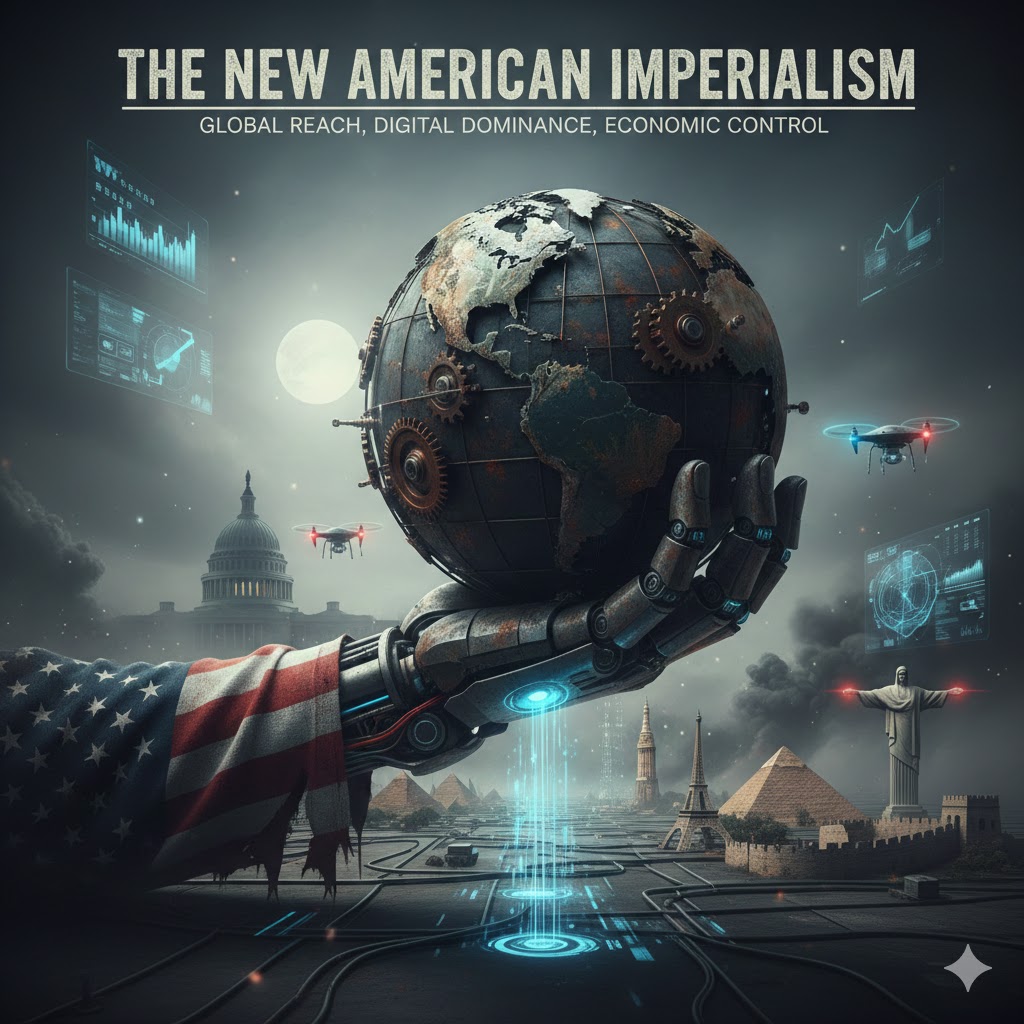
Until now. As 2026 begins, the global geopolitical landscape is undergoing a seismic shift. The traditional pillars of the post-WWII liberal order—multilateralism, collective security and democratic solidarity—are being systematically dismantled in favor of what scholars and critics alike label the "New American Imperialism." We have moved to a unilateral approach that prioritizes raw national interest over long-standing alliances like NATO.
The 2025 U.S. National Security Strategy codified this change, pivoting the United States away from being the "leader of the free world" to a "sovereign competitor" and chief force in the Western hemisphere and beyond. In support of this, we have virtually closed our borders and dramatically cut back on immigration and even deported many and removed special protection to Haitians, Somalis and others residing within our borders.
We are pursuing international hegemony over digital infrastructure, semiconductor supply chains and the global financial system and even demanded partial government ownership of major U.S. tech companies as a condition of AI chips to China. Our proclamation of tariffs and declaration of economic penalties on nations we do not like for any reason, irrespective of their past status as allies, is also an example of this aggressive American foreign policy.
Add the aforementioned "Donroe Doctrine", our territorial designs on other nations and our downgrading of our European alliances and we have a policy of new American imperialism and rejection of internationalism.
Geopolitical Consequences
The abandonment of traditional alliances has created a "security vacuum" that other powers are rushing to fill. The Europeans are making plans to reinforce their alliance and defense capabilities against Russian and even American threats.
By proclaiming our national sphere of influence, we encourage other powers like Russia and China to follow suit. Inevitably, conflicts about where those spheres start and end will arise between the great powers in this tripolar (or even multipolar) international system.
As arms control treaties expire and wars of aggression like Russia's invasions of Ukraine are not settled, we are entering a dangerous period of international politics.
By abandoning our alliances of the last three quarters of a century and proclaiming an age of U.S. hegemony, we are gambling that the United States can maintain its primacy through economic and military dominance alone, without the "dead weight" of traditional alliances.
The risks involved in this new American imperialism are huge while the rewards are unclear and ambiguous. I am not looking forward to an international future of peace and widespread prosperity unless the United States changes its foreign posture and reembraces internationalism.